
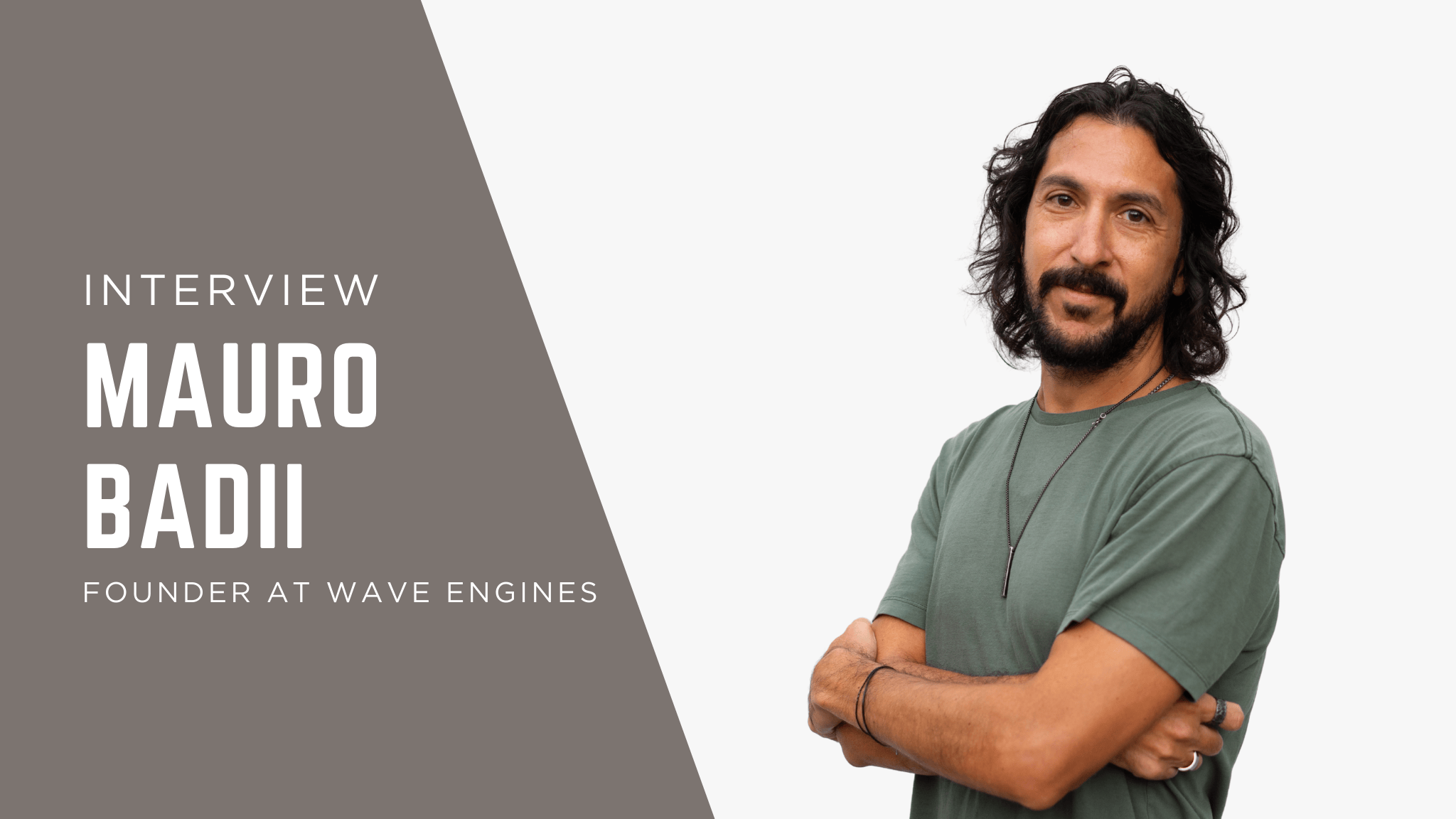
在成立 Wave Engines 之前,Mauro Badii 並不是一位典型的 VR 開發者。他是軟體工程師、音樂創作者、雕塑家,也曾擁有一份穩定的工作。然而在人生的低潮時期,他選擇辭職,暫停原本熟悉的一切。沒有宏大的創業計畫,只有一個單純的念頭——試著做一款關於太空的作品,看看會發生什麼。
最初的《Starfall》並不是為了定義某種「未來媒介」,也不是為了打造市場爆款,而更像是一場自我拯救的過程。在學習 Unity、反覆失敗、重做雙手建模與互動設計的日子裡,他慢慢找回了創作的節奏與意義。那段時間,他不是在規劃產品藍圖,而是一天一天解決眼前的問題。
或許正因如此,《Starfall》呈現出的氣質與多數 VR 作品不同。它不急著給玩家目標,也不強調勝負,而是讓人走進一種緩慢、留白、充滿想像空間的體驗。這一次,VR NEWS TODAY 專訪 Mauro Badii,談談他如何從人生低谷出發,走到今天,並在混合實境中尋找新的敘事可能。
本文為 VR NEWS TODAY 與 WAVE ENGINES 的完整專訪原文,中文圖卡版本請見文末。

Could you briefly introduce yourself or your team, and your role in the development of Starfall ?
I am the solo developer of Starfall (Demo). My name is Mauro Badii. I am a software engineer, musician, sculptor, and now a VR creator. I’ve built the demo story, mechanics, music, recorded sounds around my house and written dialogues as well as other non game activities and technical challenges needed to get this out there.
For the upcoming full experience I’m working with a dream team of collaborators and consultants in Narrative Design, Game Producer, Assets Development and VR creators to help me bring to life a one of a kind experience.
Starfall feels very different from traditional VR titles.Do you see it as a game, an immersive story, or the beginning of a new spatial Medium?
Life is an experience. Going to the movies, amusement parks, travelling, swimming under a wave, walking in the rain. All experiences build our identity. Starfall today sits somewhere between a game and an immersive story, but I see it more as exploring what spatial experiences can become. I am playing around with mixed reality as a different way of experiencing, where the player is not watching a story unfold but living inside it. Even when they quit the app.
What was the original vision behind Starfall? Was there a specific moment or idea that sparked the project?
I was going through a really low point in my life when I decided to quit my comfortable job and stop making my art as well as I didn’t feel joy or meaning any longer on any of that. Life was a struggle so I started playing around with Unity thinking I could build a game in three months (haha, yeah right), about going to other planets, because I like space, and to escape, collecting elements and simply repeat. Simple enough, right? Well, that learner mindset of trying something different, being unbound by not knowing the struggle it would really be, was enough to get me started and out of bed every day. I was living a day at a time back then, and Starfall saved me really. Later on, this energy fuels the questions about reality, memories and being present.

Mixed Reality is still being defined as a medium. What storytelling opportunities does MR unlock that simply aren’t possible in traditional VR?
In Starfall you are not playing a character or someone’s narrative. You are you. You’ve been in space and can’t remember. Mixed reality allows to augment players and their environment in ways that movies, theater or VR are limited. With a believable and compelling story, that experience is as vivid and real as it gets. Each player brings not only their room into the story but their own emotions and imagination, making the story uniquely theirs.
Designing for MR means you no longer control the player’s entire environment. How did this reshape your approach to immersion and spatial design?
Trying to be in control is the problem. And is not only the environment because players also bring themselves in.
Their life’s story shapes how they interact and what they take from every dialogue and interaction. Everyone carries joyful moments, regrets, fears and those are recognised as part of the story as well.
The story then needs to hint enough to be compelling and provide things to do but allow players to fill in the gaps with their imagination: That’s the most powerful asset for immersion.
延伸觀看|Starfall 遊戲片段
下方影片呈現《Starfall》匣道開啟之片段。
Hand-tracking plays a major role in Starfall. Was going controller-free primarily a creative decision, a technical challenge or Both?
Immersion primarily. To experience as close to reality as it can be. And accessibility as well, because you don’t need to learn any buttons or even know how to hold the controllers, simply let yourself be in it.
I must say that building the hands was the hardest technical challenge I had. I failed 3 times, got really disappointed and frustrated, up to the point I thought I would not have visible hands at all (and leave the oculus transparent hands). I had to learn so much 3D editing, meshing, weight painting and much more. When I finally achieved the hands I wanted and felt the cloth stretching differently for leather or rubber, or heard the sound of grabbing glass with the robotic hand compared to the gloved one, it became magical.
Wouldn’t you now like to know why you have a mechanical hand and one gloved hand? It’s not because I couldn’t get 2 of the same.
延伸觀看|Starfall 手部追蹤片段
下方影片呈現《Starfall》手部追蹤,對應本次訪談中所提及的設計理念。
Presence is often described as the “magic” of immersive technology. Which design choices were most critical in creating that feeling inside Starfall?
Slow pace, no traditional tutorials, no loading screen.. Is not a game. You are experiencing. Like going to the park with the dog. It’s something you do, so has to be at the pace life is. Movements and interactions must feel natural and visually plausible. The timing in which things float, wobble, rotate, spaceship movements, the sounds, the music and dialogues are all in sync in beats that provide that pace. That idea is behind of it all and inspired by the marvelous editing of the movie Dune.
Many players describe Starfall as a glimpse into the future of spatial computing. From your perspective, what does that future look like?
We are on the verge of this new way of building stories and augmenting human imagination. Movies have evolved over decades into efficient ways of generating emotions by relating to a character in a compelling story. And to think they started mimicking theater but evolved into a completely different medium. I’m no expert or visionary but it is fair to say that Spatial Computing will evolve with new ways of storytelling to the point we won’t compare any longer to computer games or even VR. Imagine, just like music can enhance your exercise routine, visual augmentation will enhance your shopping or walking in the city. Some people considered walkmans were pulling people out of reality when they first came out. Today music enhances everyone’s day.

What is your favorite VR or MR game, and what makes it special to you?
When I played “A Fisherman’s Tale” and had to move my larger-self from inside the lighthouse, being in two places at once, I remember feeling the uniqueness of VR. Same as when I played “Portal” on PC many years back, the way it forced my brain to rethink gravity and space changed me.
Out-of-this-world experiences is what VR is all about to me.
The demo leaves players wanting more — can we expect a full release? And how much larger will the final experience be?
I am building a total of 4 chapters for a 2 hour experience and I have some cool ideas for replayability so you can return and experience certain moments differently, given the knowledge you’ll have after completing it. I am hoping to release between October 2026 and April 2027 depending on how much help and funding I can get.
Lastly, is there a message you’d like to leave with our readers?
Everything we experience, in life, in VR and even in dreams, shapes who we are.
FREE DEMO:https://www.meta.com/en-gb/experiences/starfall-demo/9009782169041723/


