
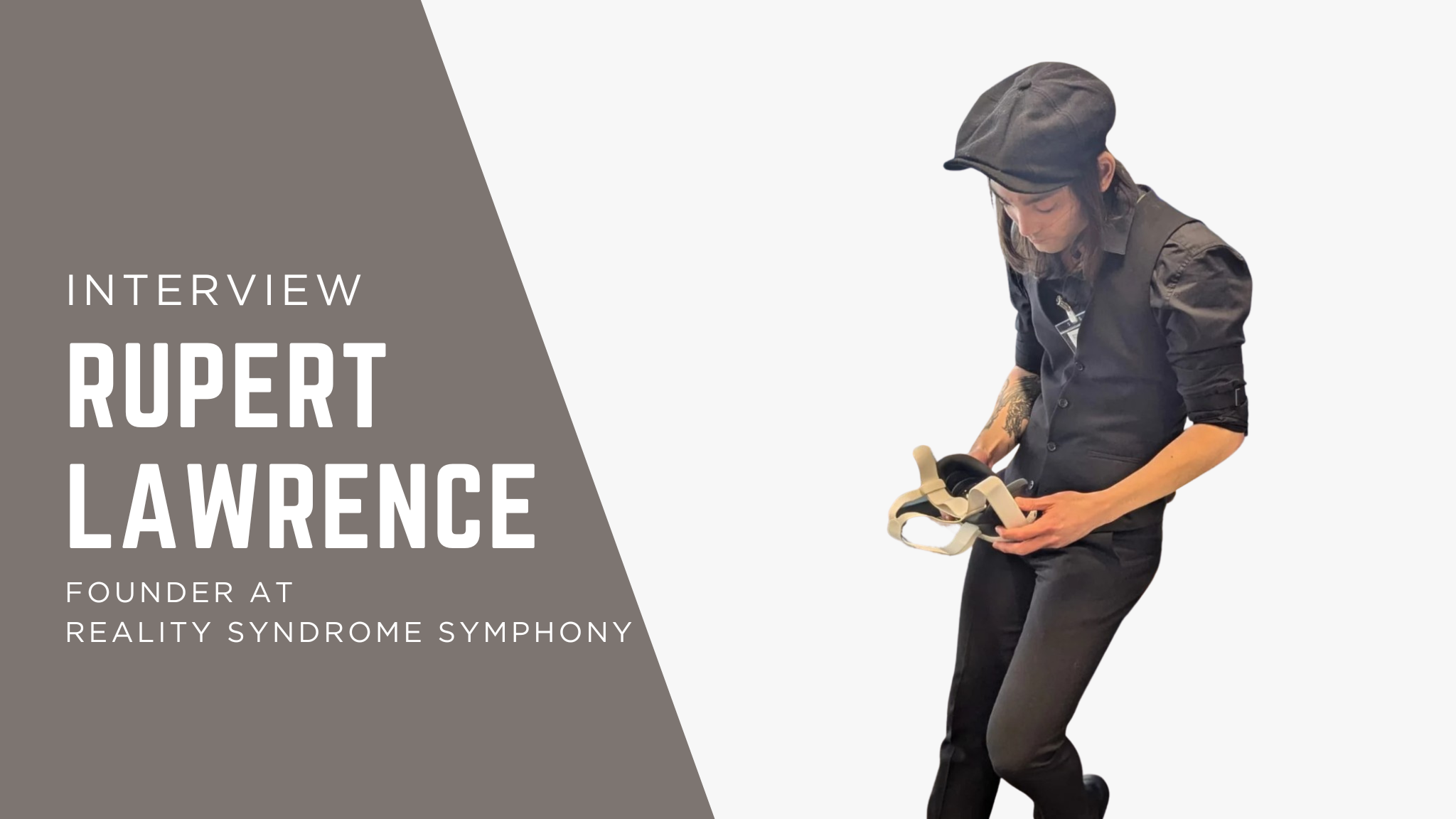
當越來越多遊戲公司開始談論 AI 生成內容、程序化創作與自動化開發時,Reality Syndrome Symphony 創辦人 Rupert Lawrence 卻選擇了一條截然不同的道路。
這位獨立開發者相信,真正的創意始終屬於人類。
從角色塑造、故事編排,到每一道謎題與互動設計,《Amelia’s Escape》並非建立在演算法生成之上,而是一款由單人開發者親手打造的 VR 敘事逃脫室作品。對 Rupert 而言,遊戲不只是系統與機制的集合,更是一種表達想法、傳遞情感,以及與玩家建立連結的媒介。
Reality Syndrome Symphony 的誕生,來自 Rupert 長年以來的夢想。他希望建立屬於自己的工作室,將腦海中的創意真正化為現實。同時,他也希望重新發掘 2000 年代遊戲設計中那些逐漸被遺忘的價值,強調玩家探索、敘事節奏與沉浸感,而非單純追求效率與數據。
這樣的理念也成為《Amelia’s Escape》的核心。
在遊戲中,玩家將化身為熱愛攝影與滑輪運動的少女 Amelia。原本只想回家的她,卻意外遭到痴迷時間旅行的科學家 Ron 綁架,被困在一間充滿謎團的房間裡。隨著玩家逐步解開謎題,Amelia 與 Ron 之間的關係也逐漸展開,讓故事成為推動玩家前進的重要動力。
與許多以解謎為核心的逃脫室作品不同,《Amelia’s Escape》試圖讓劇情與角色成為玩家持續探索的理由。每一次與 Ron 的對話、每一次發現新的線索,都像是在拼湊一段更完整的故事。而對 Rupert 來說,這正是他最重視的設計理念,讓玩家不只是破解機關,而是真正參與一段故事。
在本次 VR NEWS TODAY 專訪中,我們與 Reality Syndrome Symphony 創辦人 Rupert Lawrence 深入聊聊《Amelia’s Escape》的誕生過程、AI 與創作的關係、敘事型 VR 體驗的未來,以及他如何以單人開發者的身分完成這場關於人類創意與故事力量的冒險。
本文為 VR NEWS TODAY 與 Rupert Lawrence 的完整專訪原文,中文圖卡版本請見文末。

Q1. Could you introduce Reality Syndrome Symphony and your role in the development of Amelia’s Escape? What inspired the creation of the studio?
Hello, my name is Rupert, I am the solo developer of Reality Syndrome Symphony. It has been my dream to create my own studio with the vision to bring my ideas to life.
Reality Syndrome Symphony borrows a lot of its design philosophy from games designed in the early to late 2000s, a lot of which I grew up with. Perhaps out of nostalgia, but I really believe that a lot of design principles from that era are still relevant today and are being used less and less in modern design.
I would like to see a resurgence of these design principles in modern gaming implemented in creative ways. This studio is the proof of concept and the exploration of those principles.
Q2. Your website states that “The heart of creativity is ultimately human.” In an era where AI-generated content is becoming increasingly common, why is this philosophy so important to your team?
I believe creativity belongs in the human domain, forming the basis of artistic endeavour. It really comes down to what your definition of art is. I would say art is very deliberate, every brush stroke considered, every shot in a film perfectly placed, meticulous planning to achieve a vision or to communicate something you want to express.
Art is not just a painting on a canvas, but a culmination of the artist’s learnt skills which have been finely developed over years and a combination of personal experiences, all adding flavour to the work. This is what brings out an artist’s uniqueness.
This is something an AI cannot do or be. That is the value of creativity done by an artist. At best, AI emulates that, but there is nothing behind it. How can you stare at a piece of AI work and try to get to know the artist behind it, you can’t.

Q3. What was the original idea behind Amelia’s Escape, and how did the concept evolve into a narrative-driven VR escape room experience?
The original idea has remained largely unchanged from its inception. The idea was to create a puzzle based VR escape room.
A big theme of the design is player discovery, which extends from mechanics to narrative, it is an exploration process. When you get a hold of what the game is, you have an idea of what the game needs. So the narrative eventually developed into a main narrative with narrative parts that can be discovered by the player, allowing them to piece together the whole story.
Q4. Amelia is portrayed as an ordinary teenager suddenly thrown into an extraordinary situation. What made you choose this perspective, and how did you develop the relationship between Amelia and Ron?
The characters were chosen based on their different dynamics, they are at different stages in life with different motivations. The narrative explores this dynamic and leans heavily on it. Amelia being the adventurous teenager and Ron the troubled scientist, these two character dynamics initially clash and it is the way the personalities collide and the resolution of their dynamic which lends to an interesting story. A lot of thought was put into how the characters would interact with each other as well as the resolution of the story arc.

Q5. Many escape room games focus primarily on puzzles. How did you balance puzzle-solving with storytelling to ensure players remain emotionally invested throughout the experience?
Throughout the game Ron and Amelia are in constant contact. Each time they interact it reveals a little more about each character. With the arc there of understanding each other, this puts the player right in the heart of discovering the unfolding of the story. Their narrative in a way becomes a reward for solving the puzzles.
Q6. VR allows players to physically interact with their environment in ways traditional games cannot. How did virtual reality influence the design of Amelia’s puzzles and exploration mechanics?
A lot of VR is about using your hands. So the design became more about what can the player pick up and what objects would be interesting to mess around with.
The puzzles also needed to be differentiated from each other in a way that the player couldn’t get the puzzles mixed up. This would equate to a logical design in which the player would be able to guess or figure out the next step without too much trouble, but still allowing the player to discover the solution. The key here was balancing the amount of information needed for the player to complete the puzzle with its ideal difficulty.
In terms of exploration, looking for objects in the game world becomes more intuitive in VR as you have more freedom of movement. Scale is also an important part of exploration. The size of the space and how it is designed needs to be interesting for the player to explore, but also needs to be balanced with the scope of the game.

Q7. What has been the most difficult challenge in developing Amelia’s Escape as an independent VR project, and what lessons has your team learned throughout the process?
I would say learning to finish a project for one. Game development is more of a marathon than anything. It’s not just you making a game, there are literally different facets of the design process. Each stage requires a different set of skills or way of looking at things. Some areas you enjoy more than others.
For example, you go through a stage of fixing bugs and at times it seems never ending. It’s not the most fun stage of development but eventually you get through it with enough patience. Throughout that stage you do feel a sense of obligation to yourself and the player to get the game in the best shape it can be.
Q8. As VR continues to evolve, how do you see relaxing and social VR experiences in the future?
If there is an audience for it then it can grow. In the PC space I see a lot of casual games coming out and it would make sense for them to come to VR. Especially with the immersive quality of VR, it seems a good fit for the platform.
Q9. As VR technology continues to evolve, where do you see story driven experiences fitting into the future of immersive entertainment?
I think there will always be a need for story driven experiences. A good story is something that can have a profound effect on a person to maybe see the world in a different light. In a way it is giving back to the player that maybe you can offer (as a developer) something more than just a game with mechanics. Stories are the escapism we all need sometimes. In immersive experiences especially, a player can experience the story in a different way because they (in the case of VR) can physically inhabit the space where the story takes place.
Q10. Lastly, is there a message you would like to share with our readers and the global VR community ahead of Amelia’s Escape’s release?
Please give the game a wishlist if it interests you, release date scheduled for July 2026. There is a demo available on Steam and Sidequest to try out! Hope you will like it! Thank you for reading, really appreciate the opportunity to be featured!
Amelia’s Escape on Meta Horizon and Steam(PCVR)
Meta Horizon:https://www.meta.com/en-gb/experiences/amelias-escape/8224279467652677/
Steam (PCVR):https://store.steampowered.com/app/3263090/Amelias_Escape/


