

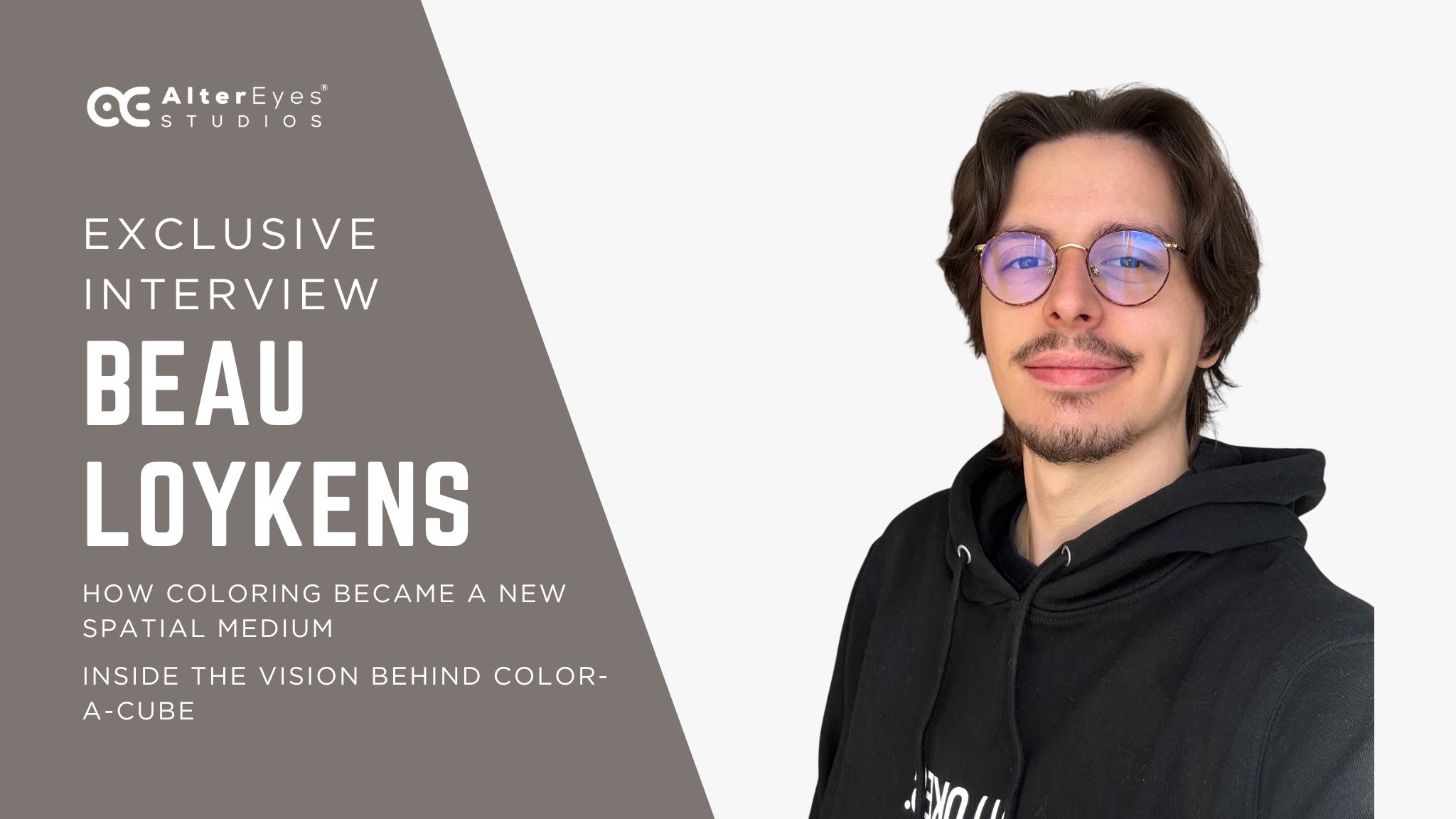
在虛擬實境產業快速追求更高沉浸與更強刺激的同時,AlterEyes 選擇了一條截然不同的創作路線。這家來自比利時的工作室,過去長期投入沉浸式科技與 XR 應用開發,從虛擬實境遊樂設施到企業專案,致力於將新技術帶入不同的場域與使用情境。然而在疫情之後,團隊開始重新思考創作的本質 —— VR 是否能成為一種更貼近日常生活的媒介?
這樣的思考最終催生了 《Color-A-Cube》 。與傳統遊戲不同,這款作品的核心並非競爭或敘事,而是一種看似簡單卻極具沉浸感的行為:上色。受到 ASMR 文化與模型彩繪的啟發,AlterEyes 將「滿足感」轉化為空間互動設計,透過細緻的聲音回饋與視覺粒子效果,建立出一種緩慢而專注的創作節奏。
在混合實境逐漸成為 XR 發展重心的當下, 《Color-A-Cube》 也展現出 VR 使用情境的另一種可能。玩家不再只是進入虛擬世界,而是將創作帶入自己的生活空間,讓沉浸式體驗與日常行為產生新的連結。這樣的轉變,使得這款作品同時吸引傳統 VR 玩家與非遊戲族群,成為觀察沉浸式內容趨勢的重要案例。
這一次,VR NEWS TODAY 專訪 AlterEyes ,談談他們如何從沉浸式科技公司轉向創作導向的開發模式,以及在 VR 與 MR 的交界中,重新思考「放鬆型體驗」的設計價值。
本文為 VR NEWS TODAY 與 AlterEyes 的完整專訪原文,中文圖卡版本請見文末。

Could you introduce AlterEyes and your role in the creation of Color-A-Cube? What kind of background and vision shaped your studio?
AlterEyes once started as an immersive technology company, making virtual reality attractions and B2B projects to bring new XR experiences to everyone all over the world.
After Corona the studio decided to try something new by making our very own VR game called Big Shots (an immersive VR alien mech-shooter game). Working on this game brought us a whole lot of different talented and creative people that have shaped AlterEyes the way it is today.
After Big Shots we pivoted to something entirely different, and went for a super cozy, relaxing game that came to be known as Color-A-Cube.
What inspired the idea of transforming voxel coloring into an immersive spatial experience? Was there a defining moment that led to this project?
Our boss loved watching satisfying ASMR video’s at the time and a big part of the team was really into painting miniatures which also felt like a satisfying experience. So our boss came up with the idea of combining the two and shape it into a relaxing coloring game where you color models with satisfying SFX and VFX. We iterated with normal 3D models at first but through iteration we quickly found that coloring cubes was way more relaxing and intuitive.

Color-A-Cube places a strong emphasis on relaxation and creativity. How did you balance simplicity with long-term engagement in the design?
We noticed early on that many players were integrating coloring cubes into their daily routine, so we made it a priority to release one free model to color every week. On top of that, we also launch a new DLC every month for players who want extra content.
We also provide loads of settings for players to tailor the coloring experience to their own liking so they can make it as hard or easy on themselves as they want.
Other than the content we also have a very strong connection with our community through our socials and Discord server where we continuously cooperate and ask for feedback and suggestions so that together we could make Color-A-Cube the best it can be.
The game uses audio feedback, particle effects, and spatial interaction to enhance immersion. How did you approach designing these sensory elements?
From the start, we put a strong focus on the ASMR aspect of the experience. We aimed for simplicity and listened closely to player feedback. Early on, we also built a content creation pipeline that allows us to integrate VFX and SFX directly into the coloring experience. Whenever I feel a sound or particle effect is missing, I work with our two very talented audio and VFX developers to add it.

Translating a traditionally flat coloring activity into VR presents unique challenges. What were the biggest design or usability obstacles you faced?
For design: In general the coloring interacactions. Coloring a model on a flatscreen gives us the oppertunity to look at other coloring games and how they handle controls, relying on a known input scheme that we can use, so it feels second nature for new players. In VR we are one of the early adopters of coloring by numbers and with the models being in 3D we had to find a way for the users to navigate the model and look for those colors.
The way we approached this is to be as intuitive as possible with the model being a grabbable object where the user can just grab the model and rotate it. Furthermore we’ve added scaling the model for users who find it hard to read and/or find the numbers that they have to color.
Together with difficulty settings, with for example highlighting the numbers that are currently being colored, we believe we hit a good middle ground for users who want a tougher challenge as well for users who just want to turn down the knob and zone out whilst coloring cubes. Even for really well hidden cubes we’ve added a hint system that highlights the position even through the model.
延伸觀看|Color-A-Cube 混合實境片段(1)
下方影片呈現《Color-A-Cube》混合實境,對應本次訪談中所提及的設計理念。
Players can experience Color-A-Cube in both VR and Mixed Reality. How does MR change the emotional or creative connection players have with the experience?
Coloring in VR is awesome but coloring in Mixed Reality is even more fun! It is just so immersive to place a model into your own world as if you were really coloring it in real life. We’ve seen tons of fun images and video’s of people using the models to interact with their environments or even use the MR feature to watch their favourite show or play with their pets while coloring, The simplicity and relaxing components of Color-A-Cube makes for the ultimate multitasking game in MR.
Accessibility and comfort are essential for relaxing experiences. How did you design the game to suit different play styles and physical spaces?
Each time we’ve had the idea of introducing difficulties we made a wide range of settings players can use to customise their own experience to whatever they prefer. Some people like to see all the current active numbers highlighted for an easier experience, while others turn off all of the hints, highlights, automatic painting ect.
You don’t really need a lot of physical space to play Color-A-Cube. But since you can scale, rotate and move the models you can make them as big as you want. We’ve seen players scaling them as big as their living room and walking around them to find all of the uncolored cubes while others mimic a miniature painting experience.
延伸觀看|Color-A-Cube 混合實境片段(2)
下方影片呈現《Color-A-Cube》混合實境,對應本次訪談中所提及的設計理念。
Color-A-Cube features ongoing content updates, themed packs, and seasonal events. How do you see this evolving as part of a longterm creative platform rather than just a standalone game?
We feel we’ve found a good cadence with one new free model every week and one DLC every month, and we definitely want to keep that up. Collaborations are also something we’re excited to continue exploring, as they’ve been a great way to keep the content fresh and reach new audiences. We also have a lot of fun new features and updates in the works that will bring new experiences and types of content with some of them introducing and inviting creativity.
From your perspective, how is immersive creativity content shaping the broader future of VR experiences?
We noticed that two very different audiences really embraced Color-A-Cube. On one hand, there are VR gamers who didn’t expect to enjoy a coloring game, but now use it to unwind after a more intense gaming session. On the other hand, there are non-gamers who own a headset mainly for lifestyle apps like fitness and creative experiences. We love that the game resonates with both groups. We think that mixed reality is awesome and believe that most of the world would have the same opinion if they got the chance to try it. We hope that Virtual Reality will become more mainstream over the years so no one has to miss out on these amazing experiences.
Lastly, is there a message you’d like to leave with our readers?
We’re extremely grateful for the opportunity to share our journey with you all and if they’ve read the article this far we’d like for them to give Color-A-Cube a go. This is one of those games that you’re quick to miss but fall in love with when you’ve tried it.
🔗 Color-A-Cube on Meta Horizon:https://www.meta.com/experiences/color-a-cube/8774301352666408/


